September 27, 2010

About Sunday's Call for Truth & Transparency

We believe it is not only our right but our responsiblity to ask for Truth &Transparency from the top officials of the San Diego Humane Society.


Yet -- we are also aware that many concerned folks who would like to join us are also afraid their participation could trigger repercussions for them or their group.

Therefore, we suggest participants wear dog (or other animal) masks to represent all the dogs who have no voice to defend themselves or tell their stories.

The wearing of masks also symbolizes the risk in speaking out to this SDHS adminstration.


Anonymous participation is most definitely encouraged. Our individual identities don't matter. What does matter is our collective courage to ask questions.

We ask questions to advocate change. If we chose to remain silent while animals die change will not occur. Animals live in our world, we do not live in their world; it is up to us-
WE ARE THE ONLY VOICE THEY HAVE

(Please note: although they are next door to each other, this gathering does not apply to the Animal Shelter in any way. We are strong supporters of the Department of Animal Services, who try to work miracles on limited funding and space.)

September 25, 2010

WHY?

We are calling for answers to questions that have been raised by the investigative news coverage (10 News and the San Diego Union-Tribune) of the San Diego Humane Society as well as in a letter signed by 11 former members of the Board of Trustees.

We acknowledge the hard work and dedication of the employees and volunteers of the SD Humane Society. We acknowledge the Society's important and long-standing place in the San Diego animal welfare community.

However the San Diego Humane Society is a private, non-profit organization, which has no affiliation with any other local or national humane society or SPCA. It is not connected in any way to the Humane Society of the United States or the ASPCA. It answers to no one but the San Diego public who maintains it with donations and the groups who fund it with grants. The San Diego Humane Society received approximately $10 million  in donations in 2009 -- more than all the other private groups combined (see letter from Board posted on this site). If this money is not going to save our animals, then where is it?

We believe it is important that no one is above public disclosure and scrutiny, especially a non-profit that exists through the generosity of our citizens and that deals with the lives of our animal companions. When the Society responds that it is a private matter that a sexual harassment and discrimination suit was settled with Society funds -- when the Society says it is a private matter what the executives are being paid, we disagree.

On behalf of the animal community, we ask for answers to the troubling questions raised in these investigations.

September 22, 2010

In response to the investigations of the San Diego Humane Society by Channel 10 News and the SD Union-Tribune and the courage of rescues, volunteers and former SDHS Board Members for speaking out, we issue:

A CALL FOR
TRUTH&TRANSPARENCY

SUNDAY, OCTOBER 3, 2010
1 PM - 3 PM

on the sidewalk in front of the
San Diego Humane Society
5500 Gaines St., San Diego

Please forward to all who care about San Diego County's animal community.
Dogs welcome. Masks welcome.
Bring signs, water and umbrellas for shade.
Sign suggestions:

Why was euthanasia not ended by 2005, as promised?

Why are most of your animals not on public view?


Where is your low-cost spay and neuter program?

Why do behavior tests sentence so many dogs to death?


Where do the millions in donations go?


What are executives paid?


Did SDHS donations pay for the 
sexual harassment/discrimination suit ?

Please don't park in the Humane Society parking lot. There is street parking available nearby. The Morena/Linda Vista Green Line trolley stop is about 2 1/2 blocks away. It is only 3 minutes from the Old Town Trolley Center.

SDHS Accused of Unnecessary Euthanisia

Ex-Volunteers: Humane Society Euthanizes Treatable Animals

SD Humane Society Says All Animals Go Through Behavioral Assessment

POSTED: 6:09 pm PDT September 21, 2010 UPDATED: 7:34 pm PDT September 21, 2010

SAN DIEGO -- Former volunteers at the San Diego Humane Society said the organization has been euthanizing treatable animals. The volunteers claimed the Humane Society is killing adoptable animals while taking money on the promise of saving them.

"I can tell you without a doubt, I've never done one where it didn't hurt, but it didn't mean it wasn't right," San Diego Humane President Dr. Mark Goldstein said when asked about the allegations.  Last year, Goldstein signed off on 510 cases of euthanasia. He said every one of those animals went through a behavioral assessment. "Its probably one of the most controversial parts of what we do," Goldstein said. "The question becomes can you predict what you see here to the future of going home."

San Diego Humane said it does not euthanize any treatable or adoptable animals at its facilities. The organization once had the goal of eliminating all euthanizing of treatable and adoptable animals in the county by 2005. That goal has now been pushed back to 2020.
Goldstein said San Diego Humane will continue using behavioral assessments to determine which animals are treatable and adoptable.

"Is it an art? Absolutely," Goldstein said. "Are we going to be doing it differently in 10 years then we do today? No doubt."
"Do you ever get it wrong?" investigative reporter Mitch Blacher asked.
"I don't think anything in life is always perfect," Goldstein answered.

Former Humane Society volunteers told 10News the behavioral assessment is far from perfect.
"Are there any animals you can think of that didn't deserve to die?" Blacher asked former volunteer Elizabeth Willes.

"Oh, yes, a number of them," Willes said. "We cannot figure out what they are doing to these dogs, whether they're lying or the dog is just so scared of the environment, but clearly there is something wrong there."

Since leaving the Humane Society, Willes joined a group called Saving Pets One at A Time, or SPOT. The group rescues dogs set to die in county shelters, including animals from the Humane Society.

Six months ago, SPOT saved a black lab named Hank.

"He failed his behavioral assessment," Willes said. "The person doing it found his behavior threatening."

The San Diego Humane Society said Hank was "unsafe to hug because of threatening behavior." They also said he "is subtle in his threats and that those threats are unrecognizable by the average public."
Hank is one of more than 100 animals who now have a home because of SPOT.

"None of these dogs have attacked anybody?" Blacher asked

"No," Willes said.

San Diego Humane found homes for 2,332 animals last year and said it served more than 38,000 animals.
"I don't believe I've ever taken the life of an animal, even here, that wasn't necessary," Goldstein said.

Goldstein said his first priority is protecting the public from dangerous animals.

The following is a statement from San Diego Humane Society regarding Behavioral Assessment Policy:

Every dog that comes to SDHS is given a behavior assessment as one part of an overall understanding of the dog's background and nature. Detailed owner history, medical history, staff and volunteer interaction notes, along with many other variables, are all taken into consideration. From a behavior assessment standpoint, we have trained staff who has been conducting these assessments for many years. The field of behavior assessment continues to mature as we all learn more. As an example, our organization recently hosted a behavior summit where we brought together some of the leading experts in the field. We hosted board-certified veterinary behavior experts including both American and European Diplomats, to share knowledge in a think-tank environment. These discussions are continuing this week in Germany, and continue to keep our organization on the leading edge of this practice.

As has been conveyed regarding the complex issues of behavior assessment, dogs are not categorized as "pass" or "fail," but rather observations gathered around this process help our staff put dogs into a category of definitions defined collectively by the San Diego Animal Welfare Coalition. These categories include "Healthy" "Treatable/Manageable," "Treatable/Rehabilitatable" or "Unhealthy."

Following the assessment and accumulation of observations and additional information, some dogs may fall into the "unhealthy" category. There are several options for dogs that fall into this category:
1) They can be returned to their owner, should the owner be interested in reclaiming the animal, with a suggested plan for behavioral follow-up;
2) We may solicit the assistance of one of our many adoption partners who we feel would benefit the animal or provide beneficial assistance in this process;
3) Depending on individual situations, other options may be considered that may benefit the animal and will still support this organization's goals of ensuring public safety and the animal's quality of life;
4) If the Hayden Act applies to the dog's situation, it can be released to a 501(c)3 if this 501(c)3 is interested in receiving the animal;
5) Or, if none of the above is a viable alternative or appropriate, the animal is further evaluated for possible euthanasia, which includes the gathering of several signatures before a final decision is made and any action taken.

In all instances where "Unhealthy/Untreatable" animals are involved, these cases are handled in a manner which ensures public safety, considers the animal's well being, and follows the law.

September 21, 2010

Letter to SDHS From 11 Former Trustees

September 17, 2010


Board of Trustees-San Diego Humane Society and SPCA

Dear Board of Trustees:

The purpose of this letter is to remind the Board of Trustees that the SDHS has accepted

donations from members of the public, promising to end suffering, and promote the adoption of pets

taken into their care. The signatories to this letter are all former members of the Board of Trustees of the

SDHS, who have all made significant contributions and donations to this organization over the last 25

years. Each has resigned due to frustration encountered when urging the Board and current management

to focus on the commitments made to the public and to the animals of this community. The Board of

Trustees must fulfill its fiduciary duty to address these issues and must do so publicly in an open and

transparent manner. More specifically, the following issues and questions must be answered:

􀂾 What Happened To The Goal of Ending Euthanasia by 2005?: : Why did SDHS fail to meet its

commitment of taking responsibility to meet the County Board of Supervisor’s goal to end

unnecessary animal euthanasia throughout the county within five years (i.e. by 2005) when millions

of dollars was solicited from the public to build the Gaines St. complex with that very goal in mind?

• In 2000, the SDHS distributed Partners for Life as part of a $21 million fundraising campaign for

the new San Diego Animal Welfare Complex in which it promised to meet this goal by 2005.

However in 2007, according to the only data made available to the public, approximately 2,500

animals were unnecessarily euthanized in San Diego County and by 2009 this number had

doubled to more than 5,000.

􀂾 SDHS’s Role in saving animals: Why does the SDHS play such a small role in helping save

animals in San Diego County while it takes in the majority of the funds donated to private animal

welfare organizations? What is the SDHS doing with the donor’s money?

• In 2009, the SDHS handled less than 10% of animal intake and adoptions in San Diego County

notwithstanding the fact it received more than $10 million in donated money-- which we believe

is an amount that is significantly more than the money donated to all of the other private animal

welfare organizations in San Diego County combined. The public deserves to know what the

money they give is being spent on.

• Adoptions at the SDHS in 2009 (2,332) were less than in 2002 (2,633) and in 1999 (3,529),

before the new Animal Welfare Complex was built, and notwithstanding an annual operating

budget that increased from under $3.7 million to more than $10 million during that time. During

this same period, the SDHS’s endowment almost doubled to $24 million. Other organizations do

significantly more with significantly less. For example, Lab Rescuers, found homes for 600 dogs

in 2009 on a budget of about $300,000. In 2009, the SDHS found homes for just over 1,000

dogs.

􀂾 Unnecessary Euthanasia: Overpopulation is the principal challenge to eliminate unnecessary killing

of animals in this county. What is the SDHS doing to address this issue? Why doesn’t the SDHS

offer a low cost spay/neuter program for low-income families?

• Virtually every Humane Society in the United States offers spay/neuter programs to help reduce

the number of unwanted animals.

• In October 2007, the SDHS and certain other animal welfare organizations announced the

formation of the San Diego Animal Welfare Coalition. The goal was to eliminate the euthanasia

of healthy, treatable and manageable animals in San Diego County. However, two years later

(2009), the number of unwanted animals increased to about 50,000 animals, and the euthanasia of

manageable and treatable animals more than doubled to more than 5,000.

􀂾 Why isn’t SDHS Helping Eliminate Unnecessary Euthanasia on The Campus they Share with

DAS-Central?: The SDHS claims it hasn’t euthanized a healthy, treatable or manageable pet in its

facility in more than nine years. However, since 2003, DAS-Central (which shares the San Diego

Animal Welfare Complex on Gaines Street with the SDHS) has had to unnecessarily euthanize

approximately 5,000 treatable and manageable animals.

It's very telling that more than 10 people have recently resigned from the SDHS’s Board of

Trustees, because of their frustration with the organizations' unwillingness to meet its goals and end the

suffering of the animals in San Diego County. We collectively have chosen to support nonprofit

organizations that truly care about ending the suffering of our homeless pet population.

What the SDHS does best is to raise money by tugging at the heartstrings of the public. When

one compares its promises to its success, it is clear that the SDHS is only interested in securing public

donations; the necessary programs have not been implemented to achieve the goals promised. It’s a sad

refrain from what many considered to be a fine organization. The current Board of Trustees of the

SDHS has a fiduciary duty to address these issues, and we ask that you do so publicly, in an open and

transparent manner.

Sincerely,

Marilyn Anderson

Elizabeth Davidson

Ron Goldman

Betsy Hilyer (Life Member)

Suzanne Koch

Bonnie Kutch

Michael Luther

Jeff Lyle

Gail McDonnell

Nancy Vaughan

Lori M Walton

Investigation of SD Humane Society

From the Union-Tribune Monday, Sept. 20, 2010
Critics say shelter broke vow to put down fewer animals

Former board members say the focus should be on more adoptions

By Tanya Sierra

When soliciting money to build a $21 million animal shelter in Mission Valley, fundraisers touted an ambitious goal for donors — to end euthanasia of treatable pets in the county by 2005.

Not only was that goal not met, but the number of treatable animals put down since 2004 has more than tripled.

The issue is one of many causing a rift among supporters of the San Diego Humane Society, as 11 former board members sent a letter last week to the current management calling the failure a broken promise and demanding more animals be saved.

Mark Goldstein, the veterinarian in charge of the humane society, said there is a new goal to end euthanasia of adoptable and treatable pets by 2020. He said the 2005 goal was admirable, but was set by a broader coalition of county and other officials and was not something his society had control over.

“The document was a compilation of an assortment of dreams, visions and aspirations,” he said of the primary fundraising prospectus. “We all had an opportunity to have our say.”

The shelter built thanks to the fundraising campaign is undoubtedly pleasant for the pets who end up there. They live in custom-decorated rooms with art on the walls, furniture to seem homey and soothing ambient sounds. The design is feng shui, with fountains.

Although the facility is larger than the old one, it fits the same number of pets because each one has more spacious accommodations.
Disaffected former board members say the atmosphere hides unpleasant facts about the society’s practices — in particular, that an unforgiving test is used to determine animals’ fates. More fail than necessary, resulting in higher euthanasia rates, they claim.

They say not enough animals are saved through adoption — a charge humane society officials reject, saying their efforts are based on quality more than quantity.
Jeff Lyle, who was on the board from 2002 to 2008, said the humane society is a powerful influence in the county and should not mislead the public about its impact.

“If the humane society wants to run a relatively small organization, that’s fine,” Lyle said. “They should tell the public this is what our role is: ‘We’re running the Four Seasons of animal welfare.’”

The humane society is not the main driver behind euthanasia statistics, as the neighboring county Animal Services facility takes more animals and puts more down. The county handles about 27,000 animals a year, eight times as many as the humane society. However, critics say the humane society should save more from the county process.

They say they county’s euthanasia trends are disturbing given that the humane shelter was built on the promise of putting fewer to sleep.
Donor Nancy Vaughn, who spent 25 years working with or on the humane society board, said she is stunned Goldstein would deny responsibility for the 2005 goal promoted during fundraising.
“He personally met with big donors and utilized the literature in soliciting millions of dollars,” she said.

Mike Luther, who served on the board from 2004 to 2008, said the humane society was supposed to reach the 2005 goal through low-cost adoption, its new larger facility, and through spaying and neutering.

In their letter on Friday, the former board members expressed concern that the Humane Society has taken in millions in donations to promote pet adoption but plays a small role in helping save animals.

They complain other organizations do more with a smaller budget and staff.
Humane society statistics show the facility took in 3,273 animals last year. Of those, 2,332 were adopted and 510 unhealthy and untreatable animals were put down. Remaining animals were sent to other shelters, died on their own or are still at the society.
Former board members say they don’t understand how an organization with such a large budget, with 148 staff including seven veterinarians and 853 volunteers can only adopt out 2,332 animals.

One reason the humane society deals with so few animals compared to the county is because they don’t take in strays. They strictly deal with owner-relinquished-pets.

“It’s about quality, not quantity,” Goldstein said. “We are role modeling.”
Goldstein and current board President Fred Baranowski say their organization does not simply focus on adopting out pets.

“It’s not bang them in and bang them out,” Baranowski said “The education component is big here.”

The humane society offers a number of classes and community outreach programs that aim to strengthen the human-animal bond and teach children that pets feel pain and require food, water, attention and love.

Test questioned

Every dog and cat that goes through the shelter is subjected to a battery of behavior assessment tests in which their temperament is gauged. Dogs are poked with a dummy hand while eating food, to test reaction. An infant doll is introduced to it as well, and behavior is analyzed around cats.

Critics say the test is outdated, and that puppies and docile breeds don’t need the assessment.

“They do the behavior assessment in a manner that causes the animal to fail the assessment,” said Elaine Godzak, a former humane society volunteer. “They fail the animal for bogus reasons so they can euthanize an animal that is ‘untreatable.’ The public would rather see pretty lies like that, rather than the ugly truth.”

Goldstein says the accusations are hurtful and untrue. He says the tests are necessary and are done to protect the public. He scoffs at the idea that he should not test every animal, saying he has a responsibility for the safety of the families who adopt his dogs.

“How would you feel if a dog you adopted was not tested?” he asked.

Goldstein admits the humane society is an expensive and luxurious operation, but he says it is run in good conscience with high standard to create an environment that will produce good pets as well as good owners.

“Measuring ourselves just by output is selling ourselves short,” he said.

September 14, 2010

Breaking News on SD Humane Society

San Diego Humane Society to cancel contract with Oceanside

By The Associated Press,
Tuesday, September 14, 2010 at 7:07 a.m.

OCEANSIDE, Calif. — The San Diego Humane Society said it will not renew its animal control contract with the city of Oceanside next month because the agency has been criticized for euthanizing animals that could be saved.

The Humane Society's contract expires at the end of October, leaving the city with no way to pick up and care for stray animals.

The agency on Monday notified city officials of the decision via e-mail. Humane Society President Mark Goldstein said the criticism from some former volunteers about its actions was a distraction.

Goldstein said he's willing to work with Oceanside during a six-month transition period if needed.

Information from: North County Times, http://www.nctimes.com/

AND FROM CHANNEL 10 NEWS
(FOR VIDEO GO TO http://www.10news.com/news/25012116/detail.html)
Humane Society Won't Renew Oceanside Contract


POSTED: 4:53 pm PDT September 14, 2010
UPDATED: 9:12 pm PDT September 14, 2010

OCEANSIDE, Calif. -- Thousands of stray animals from Oceanside will no longer be welcome at the San Diego Humane Society's north campus because Oceanside's contract for animal control services has been canceled.

The canceling of the contract by the San Diego Humane Society came as a shock to Oceanside city leaders. Since the 1960s, the city's stray animals have been brought to the shelter.

The San Diego Humane Society took over shelter operations in January and with that took over the contract negotiations for Oceanside's animal control services.

"We thought the negotiations were going fine," said Oceanside city real estate manager Douglas Eddow until he received an e-mail from San Diego Humane Society Director Dr. Mark Goldstein.

"They indicated that they wanted to pursue what they normally do as a humane society and they thought it would be a little more difficult if they continue the animal control animal sheltering services for Oceanside," said Eddow.

In recent months, the San Diego Humane Society has been under fire by animal rescue groups who have called into question the nonprofit's policies, especially how many animals they euthanize.

Kris Nelson, a former volunteer, has since formed an Oceanside-based rescue group.

"Was the money coming in from the $700,000 dollars contract enough to put up with the disruption? People asking questions about his operation? He's not used to that," said Nelson.

The director of San Diego’s Humane Society was unavailable for an interview but in a written statement to 10News, the human society said the change is an effort to focus on their "core services and education programs" and that "we believe we can have an even greater positive impact on the animals and Oceanside community."

The contract is set to expire October 31 but the animals' future remains uncertain.

"It means that the strays will be running in the streets," said Nelson.

The humane society has promised a transition period.

"We need to negotiate the terms of that six-month extension to transition," said Eddow.

Nelson has already been out searching for a new shelter facility alternative and said she remains hopeful.
"There are lots of things we can do that San Diego Humane refuses to because it does not bring in money," said Nelson. "We want to do things to help the animals. We want to be a true humane society and we can do it."
The San Diego Humane Society also contracts with the city of Vista for its animal control services, which they plan to continue

COMMENTS? FEEL FREE TO JOIN IN BELOW..

September 09, 2010

Another Dead Orca at San Diego SeaWorld

FROM PETA:
Another orca just died at SeaWorld San Diego—this time a young orca named Sumar. I'm hoping that you can take some time this Saturday to join the nationwide day of action to stop SeaWorld's cruelty to animals.

Believe it or not, Sumar was the son of Taima, who died at SeaWorld this summer, and he was fathered by Tilikum, who killed a SeaWorld trainer earlier this year! How many people and animals must die before SeaWorld stops holding animals captive?

We're coordinating protests outside SeaWorld locations across the country this Saturday, and it would mean so much if you could join your local community members in speaking up for captive animals. We must send a clear message to SeaWorld that these tragedies need to end and that life in a concrete tank is no life at all for these wild animals!
What: Day of Action Against SeaWorld
When: Saturday, September 11, 11 a.m. - 1 p.m.
Where: Outside SeaWorld, 500 SeaWorld Dr., San Diego (Please meet at the corner of SeaWorld Drive and Sea World Way.   Park in the first dirt parking lot on the right hand side of Mission Bay Parkway off of SeaWorld Drive here.)

All materials will be provided, so just bring yourself and anyone you can recruit to join you! For questions or to RSVP, contact me at EricD@peta.org and be sure to include in your e-mail the name of the city where the protest that you will be attending will be held. You can also RSVP on Facebook and help recruit more people to come out by inviting them to the event, cross-posting this message on Facebook and Twitter, and e-mailing everyone you know!

August 31, 2010

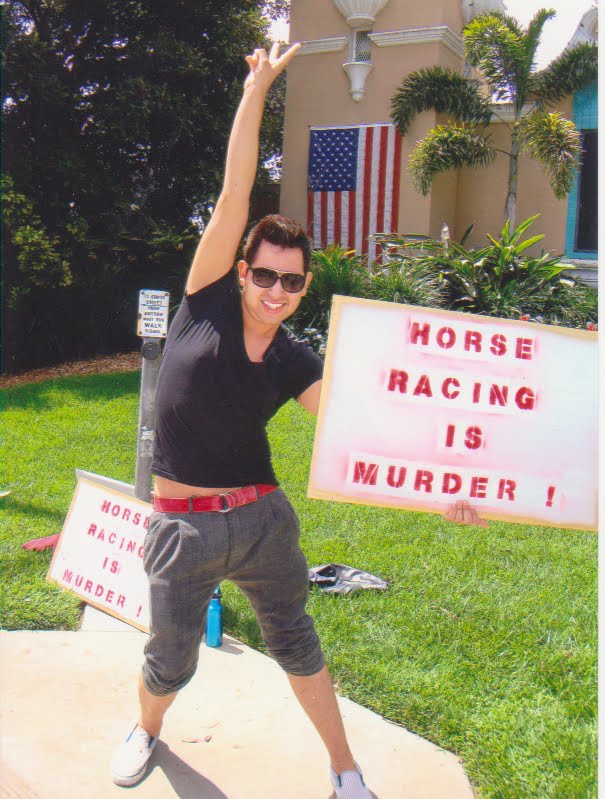
Del Mar CRUEL AS EVER! August 28 Protest

We had a great turnout and enthusiastic participation for our Del Mar Races Third Annual Protest. Thanks to everyone who came to stand up for the victims of the horseracing industry -- the horses. Our protest was covered on three San Diego TV channels -- 8, 10 and 6. We also had pre-protest coverage on Channel 10 the night before. Someone who works at the track gave an undercover interview, essentially confirming our allegations. That video is also available on this website as well as the Channel 6 coverage. 


Over 300 racehorses died last year in California alone. Thirteen horses died at Del Mar in 2009 and as of the date of our protest, August 28, 2010, eight horses have died this year with two weeks left in the season.
Despite the fact that Del Mar has a new "safer" synthetic track, horses continue to be injured. It is estimated that 15,000 thoroughbreds were sold at auction last year to be slaughtered in Canada or Mexico and processed for human consumption. These animals have served the entertainment industry AKA the racing industry for their lifetimes and are then slaughtered in the most inhumane ways imaginable.
THE SAD TRUTH
Racehorses are given numerous drugs to mask pain and improve perfromances. Steroids are currently banned, but the non-steroidal pain medications and muscle relaxers are still legal in certain doses.

A surgical procedure known as "heel nerving" or Posterior Digital Neurectomy involves severing the nerves along the back of the lower leg. This allows the horse to continue running through pain. This also reduces sensitivity, making racing more dangerous for horses and jockeys.

Racehorses often suffer from a condition known in the racing comunity as EIPH-Exercise Induced Pulmonary Hemorrhage, or bleeding into the air passages and lungs. Each horse must receive a therapeutic dose of a diuretic called Lasix (furosemide) prior to a race in order to decrease the risk of EIPH. The goal is to allow the horse to run faster. It also causes rapid fluid loss.
WHAT CAN WE DO ?
Contact The California Horse Racing Board, The National Thoroughbred Racing Association, The Jockey Club, The Del Mar Thoroughbred Club. Tell them that as a compassionate public, we are tired of the unnecessary suffering of these beautiful sensitive animals and want this to stop! This is suffering for entertainment, not sport! Boycott the races and tell them why. Visit http://www.afterthefinishline.org/, a non-profit that assists in the placement of retired racehorses. Tell our local media you want more information about horse deaths and injuries in our news coverage. Most don't report them at all.
                                                                                --Thanks to Darlene for your important research


Del Mar's To-Date Death Toll
#1. Conato, broken left hind ankle July 28
#2. Beach Bottom Bay, broken front leg July 31
#3 Tuscan Evening, heart attack Aug. 8
#4 Love at the Bay, broken left front leg Aug. 13
#5 Fantasy Free, broken right front leg Aug. 14
#6 Rockstar Ben
#7 Roos On The Loose
#8 Ukandoit

Urgent Alert for California

California Assembly Bill 2012 will increase the amount of jail time a judge may issue to a person convicted of animal neglect. This ASPCA-supported bill has already passed both houses of the California Legislature by large margins with bipartisan support. Governor Schwarzenegger has less than a month to sign this important legislation into state law.

Animal neglect is a form of cruelty that is both more insidious and more common than the beatings, fights and acts of torture that tend to grab headlines. Neglect causes extreme, prolonged suffering—sometimes resulting in death—and is just as serious an offense as intentional physical cruelty.

The maximum jail sentence for a neglect conviction in California is currently six months. AB 2012 would raise that maximum sentence to 12 months, bringing the penalty for animal neglect in line with the current penalty for intentional cruelty.

What You Can Do
Please be the animals' voice and contact Governor Schwarzenegger to urge him to sign AB 2012 into law. You can reach his office at (916) 445-2841.

Visit the ASPCA Advocacy Center today for some tips on what to say when you call, and remember to thank the person you speak with for considering your views.

August 28, 2010

Racehorses -- Bred for Death?

From the LA Times
As we explore the limits of physical performance, sports trend toward the more extreme, even if it harms rather than enhances the athlete's health. Steroids in baseball, eating disorders in prepubescent gymnasts, whatever it takes to win, until there's a public pushback that threatens the sport. Without industry reform in the near future, it's easy to imagine such a pushback against the biggest athlete of all -- the racehorse.

No one knows how many fatal racing injuries occur nationwide, which is troubling all by itself. How can the horse racing industry control the problem without a firm count and an analysis of what the circumstances were in each case? The most prevalent estimate is 1.5 such accidents per 1,000 race starts. That amounts to roughly two per day. As awareness grows, it's unlikely the public, ever more concerned about animal welfare, will calmly accept the death by racing injury of more than 700 horses each year.

Some obvious suspects in the injuries have been dirt tracks, the intensity of training and the breeding for speed: muscular, 1,000-pound bodies coming down on ankles as thin as ours. A story in Friday's Wall Street Journal took an even closer look at breeding, prophetically wondering whether the prevalence of Native Dancer's DNA in today's top racehorses is raising the chances of leg injury. Native Dancer, which died in 1967, was known for heavily muscled legs and a "violent, herky-jerky running style" that left him and many of his progeny with a tendency toward foot problems, the Journal reported. Overbreeding has exacerbated the problem.

For all the anthropomorphic talk about racehorses being "family" and "valiantly" striving to win or overcome injuries, the horses have no choice in this multibillion-dollar industry. The racing world would be smart to put a higher priority on reining in horse injuries and deaths, before public outrage leads to calls for more draconian controls.

August 21, 2010

How San Diego Shelters Evaluate Animal Behavior Discussed at Summit

By RAY HUARD - rhuard@nctimes.com North County Times - Californian Posted: Friday, August 20, 2010 6:16 pm

Too often, dogs and cats brought to animal shelters are euthanized because behavior problems make them unsuitable for adoption, according to officials with the San Diego Humane Society.

The Humane Society itself has come under fire from some volunteers at the former North County Humane Society for being too quick to kill animals that they said could be retrained and saved. The San Diego group absorbed the North County agency in January.

To get a better handle on behavior problems of shelter animals, the Humane Society assembled national and international animal behavior specialists for a two-day animal behavior summit that started Friday at the society's San Diego headquarters, said Renee Harris, the Humane Society's executive vice president of animal services.

The big question that behavior specialists will try to answer at the summit, Harris said, is "How can we address the animals in our shelters that are exhibiting behavior problems?"

Although the summit will deal with some of the issues raised by former volunteers at the North County shelter, Harris said it was planned well before agency took over the facility on San Luis Rey Road in Oceanside.

"We really want this to be a think tank to work through our issues," she said.

Critics have complained that animals that would have been put up for adoption in North County before the merger were shipped down to the Humane Society's San Diego shelter, where their behavior was assessed and those found wanting were put on a list to be euthanized.

Harris and Humane Society President Mark Goldstein have insisted that no healthy, adoptable animals are killed at the Humane Society.

"We have not had to euthanize a healthy or treatable animal for the past 10 years," Goldstein said.

The difficulty is defining what constitutes "treatable," Harris said. She said that's one of the things that will be refined coming out of the summit.
Typically, dogs and cats brought to an animal shelter are under stress.

With dogs, that can come out as aggression, or as fearful, submissive behavior and what animal control workers call "kennel stress neurosis."
"They may be licking the walls and won't stop. You even get a glassy look in their eyes," Harris said.

The challenge for organizations like the Humane Society is determining whether that stressed behavior is something that can be overcome with training, or whether the animals have been so stressed that their behavior has become ingrained.

"Maybe there's something we can do differently for those dogs to make them comfortable," Harris said. "What do we need to provide to make them different?"

Harris said the experts at the summit will look at the ways the Humane Society and other organizations assess animal behavior in determining whether a dog or cat is suitable for adoption, Harris said.

The whole issue of animal behavior in shelters "is sort of an evolving, unofficial science," said Michael Baehr, Humane Society marketing and communications director.

The seminar, which was scheduled to conclude Saturday, is part of the Humane Society's Paws to Success program, started in 2008, with a goal of developing programs so that by 2020, euthanasia of treatable animals will not be practiced in any San Diego County animal shelter, Goldstein said.

Conclusions and recommendations coming out of the seminar will be used by the Humane Society and other members of the San Diego Welfare Coalition to tailor programs to save more animals, Harris said.

Coalition members include the Escondido Humane Society, Rancho Coastal Humane Society, Chula Vista Animal Care Facility, San Diego County Department of Animal Services and El Cajon Animal Shelter, Harris said. She said the information would also would be shared with organizations that deal with abandoned and stray animals.

"We'll build our piece and then somebody else builds on that," Harris said.

Call staff writer Ray Huard at 760-901-4062

August 18, 2010

Puppy Mill Legislation to be Proposed for Hawaii

LCA Exposes Hawaiian Puppy Mill Cruelty!

Hawaiian State Senator Proposes Legislation!

Last Chance for Animals has just exposed a major Hawaiian puppy mill operation located in Waimanolo, HI. The LCA special investigations unit received a tip that a puppy mill was operating in an otherwise idyllic setting 30 minutes outside Honolulu. The SIU sent an undercover operative to the island to see if he could get a job at the mill. Once on site we discovered multiple breeds of dogs and dozens of puppies being bred and sold wholesale to island pet stores. At one pet store, The Pet Spot in Pearl City, owned by the same woman who operates the puppy mill, customers were being misled about the origin of the animals they purchased.

Our investigation uncovered dead puppies born in squalid conditions, dogs with severe medical problems and major rodent infestation. In the words of LCA's investigator, "For seven days every day I asked the same question when are you going to fix the poodle (that had a cancerous tumor)? And they said today it's going to the vet, so I got that answer for seven days straight. It never went."
LCA shared our footage with a reporter at Hawaii News Now. They ran a two part expose' regarding our investigation and the lax laws that have allowed a festering dog breeding problem in Hawaii.

http://www.hawaiinewsnow.com/Global/story.asp?S=12989791

LCA is pleased to announce that as a direct result of our investigation Hawaii State Senator Clayton Hee (D) stated he will be introducing legislation to address the issue. We will keep you updated when that happens. Also as a result of the investigation and a follow up by the Hawaiian Humane Society, two dogs that were rescued from the mill have been rehabilitated and adopted to good homes.

August 16, 2010

Del Mar Horserace Protest August 28 11:30 AM

The Animal Defense Team has scheduled its third annual protest outside of the Del Mar racetrack entrance. PLEASE JOIN US! EVERYONE IS WELCOME AND NEEDED! Bring signs, water and your compassion for the victims of an industry based on greed, drugging, deception and death.

WHEN
Saturday, August 28, 2010
11:30 AM - 1 PM
This is the $1 Million Pacific Classic Day, the biggest purse of the season. Post time is at 1 PM

WHERE
The intersection of Jimmy Durante Blvd. and Via de la Valle, under the Del Mar marquee at the corner.

WHY
Horses are now bred for speed not strength, raced too young and legally (and illegally) drugged to run through pain and others problems like bleeding into the lungs. Every year, Del Mar loses many horses who break down on the track or in training.

The losers of Del Mar's richest "betting" day on August 28 will far outweigh the winners and death is imminent. Seven out of ten horses are slaughtered in the U.S., not because they are in pain, suffering or living with a terminal illness -- they are slaughtered because their owners don't want them anymore. For the thoroughbred, the risk of death is greater if they are injured or they finish last where the turf meets the surf in Del Mar. If your favorite horse doesn't make a good showing in the race, chances are the next stop is the slaughterhouse. Horses are trucked across the border into Mexico and Canada where they are slaughtered under the most inhumane methods imaginable.

Information: keafs2@yahoo.com and the Racehorse Memorial Wall scrollsequus.blogspot.com
The San Diego Animal Defense Team denounces all forms of "animal entertainment" for human pleasure. Whips, beatings, starvation and isolation are all a part of "training" an animal for human command and control. There is nothing exciting about suffering and pain. Please do not support animal entertainment of any kind, beginning with horse racing.

August 12, 2010

THE BOXERS ARE READY FOR NEW HOMES! ADOPT NOW!

The Boxer dogs confiscated from Boxer Rescue in San Diego are now released and ready to be adopted. PLEASE consider taking one of these great dogs into your family. They have been held at Animal Control for 5 months and are desperate to go to forever homes.


What you can do:


Go to the Central Shelter of Animal Services.
5480 Gaines St. San Diego CA 92110


Complete one of the applications. Only a few of the Boxers are on the floor for public viewing. Most are not.                                                                                                  
You will be contacted for an appointment time to meet the dogs
and possibly choose one that is best for your family.


They range in age from 2 to 9 years old. Most are purebreds, some are mixes. The adoption fee is $69.00. A home inspection is required.

HELP THE BOXERS GO HOME! This is an absolutely wonderful breed.  Fun! Playful! Smart! Great with families!

If you want a dog to be your best buddy, this is the breed for you. Save a life and give yourself a treasure.

August 09, 2010

El Paso City Council to Vote on Puppy Mill Ban

August 9th, 2010

From Animal Legal Defense Fund
aldf.org

Contact:
Megan Backus, Animal Legal Defense Fund
Tom Linney, Animal Legal Defense Fund

El Paso, Texas – Tomorrow morning, the El Paso City Council is voting on Mayor John Cook and the Animal Welfare Advisory Committee’s proposed ban on the sale of non-shelter dogs and cats at pet stores – effectively banning the sale of animals bred at filthy “puppy mills.” A representative of the national non-profit Animal Legal Defense Fund (ALDF), which has advised the Mayor office on the ordinance, will appear before the City Council to speak in support of the ban. The ordinance, which would be the first of its kind in Texas if passed, allows for an exemption for the adoptions of shelter and rescue animals and for people who purchase animals directly from a breeder.
When: Tuesday, August 10, 2010, 8:30 am
Where: Council Chambers, City Hall, 2 Civic Center Plaza, El Paso

El Paso joins a growing list of cities in America to consider retail pet sale bans. Since Albuquerque, N.M. passed a similar ban, animal adoptions have increased by 23 percent and euthanasia at city shelters has decreased by 35 percent. South Lake Tahoe and West Hollywood, Calif. have both passed bans, and other cities in Florida, New Mexico, Missouri, and elsewhere are currently considering similar bans on the sale of dogs and cats from pet stores.

Puppy mills are commercial "factories" where the "product" is puppies and dogs who are treated as machines. “Breeding” dogs are kept in overcrowded wire cages for their entire lives with little, if any, human contact or veterinary care. If the puppy mill is outdoors, the dogs are unprotected from the cold of winter and the heat of summer. They live with the stench of their own urine and feces and, if the cages are stacked on top of each other, the dogs on the lower level are hit with excrement from above. “Puppy mill puppies are sold in pet stores,” explains ALDF attorney Tom Linney, an El Paso resident who will speak before the City Council in support of the ordinance. “The simplest way to assure concerned El Paso consumers that they are not supporting puppy mills is to ban the sale of animals at pet stores, and to encourage ‘pet stores’ to serve as facilities for adoptions from shelters and rescue groups instead.”

ALDF was founded in 1979 with the unique mission of protecting the lives and advancing the interests of animals through the legal system. For more information, please visit www.aldf.org.

August 05, 2010

Outrageous! Urge Homeland Security Not to BUY Dogs

The U.S. Department of Homeland Security (DHS) announced that it wants to buy 3,000 dogs from breeders in order to increase its force of canines who sniff out explosives, cash, and drugs. With thousands of homeless dogs who would make excellent candidates for the program already in animal shelters across the country, the DHS should follow the lead of New England Assistance Dog Services and many police departments and fill its ranks with dogs adopted from animal shelters and breed rescue groups instead.

We are in the midst of an animal overpopulation crisis in the U.S., and yet the DHS plans to pay breeders to produce more dogs! Only 20 percent of dogs who are selected for service programs successfully complete the training process, so this plan could actually result in another 15,000 dogs ending up homeless!

The "success rate" of service dogs adopted from animal shelters and rescue agencies is the same as that of dogs who are bred for certification jobs. Animal shelters everywhere have the type of dogs the DHS is seeking—dogs who are outgoing, alert, active, extremely people-friendly, and of certain breeds, such as Labrador retrievers, golden retrievers, and German shepherds.

If the DHS adopts homeless dogs for the program, it's a win-win situation. It would save taxpayers thousands of dollars because adoption costs at animal shelters are far lower than the prices that breeders charge for puppies. The average price that the DHS paid for the 322 untrained dogs it purchased between April 2006 and June 2007 was $4,535 per dog! Adopting dogs from animal shelters would also help curb the animal overpopulation crisis, while giving the dogs an opportunity for an exciting and fulfilling life.

Please take a few moments to contact DHS Secretary Janet Napolitano and ask that the agency adopt dogs from animal shelters and breed-rescue groups rather than buy dogs from breeders.

Campaign letter writing information is available at Peta.org Action Center.

August 02, 2010

From the New York Times: The Animal Cruelty Syndrome

Please check the link below. This article should be read by everyone!

http://tinyurl.com/26nu2w5

Declaring Freedom for Animals from Harm, Illogic and Wrongheadedness

From the Animal Legal Defense Fund:


Posted by Dana Campbell, ALDF Attorney on August 2nd, 2010

“We hold these truths to be self-evident” begins the famous line from the Declaration of Independence. I’ve got my own version: We hold these truths to be self-evident: that one and one is two, that the sky is blue, and that abused animals should not be returned to their abusers. Yet I must live in an enlightened animal law bubble to think the last concept to be self-evident, because plenty of others do not think it so obvious, or even consider the idea at all. What am I talking about? Judges and attorneys who see nothing wrong with returning animals back to defendants who plead guilty to animal cruelty or are convicted of it after a trial, thus putting the animals right back in harm’s way again, sometimes after having recovered in foster homes from their horrific ordeals.

In what I hope does not portend a trend, twice this year in separate New York counties (Erie and St. Lawrence) judges went so far as to order animals to be returned to their abuser before trial, and unbelievably, without even having a hearing on the matter! That’s right, no inquiry as to the basis for the criminal charges supporting the animal’s seizure from the abuser, even though the law provides for such in the form of a bond or forfeiture hearing. No effort made by the court to even ascertain whether the conditions had improved since the charges were filed and were now adequate to support the return of animals to their accused abuser. Such judicial arrogance is not only legally improper, it is shockingly inappropriate.

One way to combat this is to pass legislation taking away discretion to hand back abused animals, in the form of mandatory forfeiture of all animals upon conviction, and prohibiting convicted abusers from having contact with animals, as Oregon and several other states have done. ALDF has model laws that may be used as samples for legislation here.

Surely I am not the only one who thinks returning animals to their tormenters is self-evidently wrong?

July 22, 2010

Del Mar -- CRUEL As Ever

For the first time in the history of the Del Mar horse races, four members of the San Diego Animal Defense Team successfully infiltrated Opening Day AKA Hat Day on July 21, wearing large hats protesting the cruelty of horse racing.

The team officially entered the Opening Day hat contest, sponsored by track officials and billed as "The One and Only Truly Fabulous Hats Contest." They then joined the Parade of Hats, potentially exposing thousands of horse race fans to creative visuals of the cruel reality of racing.

Each hat was individually crafted. One featured "My Pretty (Dead) Pony." Another boldly stated "Racing Kills." The third was topped with three dead horses and a tombstone engraved with  "Del Mar 2009 -- 13 horses dead / 2010 -- ???" The fourth hat featured a prominent banner: "Remembering the valiant horses who gave their lives for 'sport,' " trimmed with ghost horses with targets on them.


July 21, 2010

Judge Orders Nearly 500 Puppy Mill Dogs Turned Over to Texas Humane Society

July 17, 10:32 PM
Dallas Animal Rescue Examiner
By Rebecca Poling

Late this afternoon, a Montague county judge ruled in favor of the Humane Society of North Texas, giving HSNT custody of nearly 500 dogs rescued last week from a puppy mill in Bowie, Texas. The dogs, from Heddins Kennels/Maggic Pets Kennels, in Bowie, Texas, were emaciated, sick, and starving. I know. I helped care for them after they were rescued. I spent last weekend in Fort Worth a the warehouse where they were being held. I saw them. I cared for them. And I loved them.

Several "family dogs" will be returned to the kennel owners, Carol and Cloyce Heddins and those dogs will likely suffer a fate I cannot even imagine.

The Heddins were ordered to pay $40,000 to the Humane Society of North Texas for the cost of caring for the dogs, but so many were sick and needed expensive veterinary care that this heroic effort is likely to leave HSNT financially drained.

Regardless, most of the dogs are safe for now and Maggic Pets will soon be out of business. And the good guys will soon move on to raid another puppy mill, here or elsewhere, until one day our society wakes up and realizes that that those cute puppies in the window of the pet store are the reason puppy mills exist. If you buy a puppy from a pet store, you're enabling people like the Heddins to benefit financially from the suffering of animals. Putting pet stores out of business will put puppy mills out of business. It's as simple as that.

July 13, 2010

July 12, 2010

Bring All Commercial Dog Breeders Under Federal Oversight! - The Petition Site

Bring All Commercial Dog Breeders Under Federal Oversight! - The Petition Site

URGENT! Please click on the link above and sign the petition! For a discussion of the PUPS Act, scroll down to our entry on Friday, June 25 -- PUPS Act Response to USDA Puppy Mill Audit

July 11, 2010

We Are Making A Difference!

6/10/10 "Description Of This San Diego Puppy Shop Business For Sale: asking price ($180,000) is reduced and available sellers financing for qualified buyer. bring offer. also owner this store just added puppy financing for customers. This is a great program. The way it works is that, if a customer has no money then store offer puppy financing through a bank. Its an instant financing program to the customer. There is virtually no competition for this type of concept. The store sells quality and pedigree purebred puppies from the industry’s top Breeders. Also, carry brand name and trendy doggie accessories. sales are growing by the day. Not marketing or advertisements has been done ( Not Needed). Only relies on mall traffic. Christmas, Valentine’s Mother/Father’s day, and graduation are Extremely Busy. The store is located in front of the most popular movie theatres, famous national restaurant, food court, and main strip of the center."
Photos included with this ad match the Mission Valley Puparazzi store.
Animal Defense Team is on the march! Heading in to Mission Valley Shopping Center to protest at Puparazzi Pet Store. Thanks to everyone who has joined us in our protests at pet stores that sell puppies.   Which one will be next???

UPDATE! San Francisco Proposed Pet Sales Ban

San Francisco hits nerve with pet sale ban idea

By EVELYN NIEVES, Associated Press Writer

Saturday, July 10, 2010 at 11:04 a.m.

SAN FRANCISCO — As Philip Gerrie tells it, the idea of banning pet sales in San Francisco started simply enough, with a proposal to outlaw puppy and kitten mills.
West Hollywood, Calif. had done it, with little fanfare. Why not the city of St. Francis, patron saint of animals, which prides itself on its compassion toward all creatures great and small?
So Gerrie, a bee keeper and secretary of the San Francisco Commission of Animal Control & Welfare, a seven-member advisory board on animal issues to the city's lawmakers, decided to suggest adding the idea to the commission's agenda.

"Then we came across the idea of adding small animals as well," Gerrie recalled, "since all these animals are being euthanized" by animal shelters.

The proposed ban on puppy and kitten mills became a proposed ban on the sale of just about every animal that might end up in a shelter: gerbils, guinea pigs, birds, hamsters, turtles, snakes, rats. Sales of rabbits and chicks are already banned in the city.

The idea came back to bite the commission. It led to the panel's biggest, longest monthly meeting in recent memory, not to mention blogger fodder around the world.
Animal control and welfare commissioners say all they planned to do at their regularly scheduled meeting Thursday evening was discuss the idea, hear out those on all sides of the issue - pet store owners, rescue groups, pet owners and maybe, just maybe, take a vote on a ban.

After a vote, the proposal would have to find a sponsor, preferably two, on the Board of Supervisors, pass muster as legislation with the city attorney, and then pass the Board.

But once Gerrie's idea made the front page of The San Francisco Chronicle Thursday - "Sell a guinea pig, go to jail," the story began - it was famous.
Or infamous. The Chronicle story prompted 793 comments and counting, many playing on only-in-San Francisco stereotypes. "Bay area people truly are nuts!" read a common refrain. It prompted CNN's Jack Cafferty, who called the idea "not half bad," to ask readers their thoughts, prompting 15 printed out pages of debate from around the globe.

And the commission's regularly scheduled meeting, usually attended by a handful of spectators, became a standing room only spectacle of close to 100 people, with some spilling into the hallways, and speakers lined up for hours.

The guinea pig rescue people showed up. The rabbit rescue folks came. The bird rescue people showed up in force, including Mira Tweti, who decried the plight of captive parrots and how often they are dumped by owners who find them too demanding.

"I thought it was the longest meeting we've ever had," Gerrie said, adding that he thought the several hours were productive, brought a lot of attention to the issue nationwide and "got people talking."
And yet, he said, "I would love to get this behind me."
That will have to wait a little while. The commission, overwhelmed with varying opinions, voted not to vote, tabling the debate until at least another month.

The Associated Press

July 09, 2010

Seattle Humane Society Takes in Southern California Shelter Dogs

Posted July 8, 2010
When it comes to saving lives, cooperation between rescue organizations is crucial. We currently have kennel space to help support other shelters who are desperately in need. Our staff makes weekly calls or visits to the King County Shelter in Kent first. When we still have life-saving kennel spaces to offer, our team reaches out to rescue partners across Washington state and beyond to see if we can help.


Many of you have heard that thousands of dogs are being euthanized in Southern California due to space constraints. At just one organization, they take in 50,000 animals annually and only 60 percent are placed.
This story of innocent pups not having a chance is gut wrenching to many of us who are looking at available kennels here at the Seattle Humane Society. And so, as part of our life-saving mission, we've joined other shelters across the United States to help rescue dogs in Southern California.

Our team arrived at our Bellevue campus early this morning with 62 dogs from the LA City Shelters. Thanks to a great team effort, all of the dogs were spayed/neutered, vaccinated, microchipped, heartworm tested and given health certificates before making the trip north. Now we will give them as long as it takes for us to find them homes of their own.

All of the dogs' pictures and profiles will be posted on our website at seattlehumane.org over the weekend after we give them another veterinary exam and a behavior evaluation. So check in soon! Better yet, come visit them at our shelter in Bellevue and help us find each and every one of these wonderful pups the family they deserve.
We're located at 13212 SE Eastgate Way, just off I-90 at the 405 interchange and open seven days a week from noon to 6 p.m.
seattlehumane.org

July 06, 2010

Animal Shelters Full! Companion Animal Crisis Continues in San Diego!

From North County Times
REGION: Animal shelters full with little room for surrendered pets Adoption

prices cut as officials work to make more room By SARAH GORDON -

sgordon@nctimes.com
Posted: July 5, 2010 4:14 pm

North County animal shelters are brimming with cats and dogs, and two are
offering incentives to encourage people to give the pets a home. The shelters
are so full that few are taking animals surrendered by their owners. At the
Escondido Humane Society, all adoptions are half-price in the month of July,
said shelter spokeswoman Katie Woolsey. "We are very full ---- summertime is
our busiest time of year," Woolsey said. The shelter has kennels in hallways
and offices to make room for all its adoptable pets, which recently was 57
cats, 42 kittens, 64 dogs, one puppy and 42 rabbits. Woolsey said summer can
be the best time to take an animal home because kids are out of school and
parents are home more often. "It's kind of an ideal situation to bond with a
new pet and spend more time to allow it to adjust," she said. The Escondido
shelter, which has contracts with that city, Poway and San Marcos to provide
animal control services, is only taking in animals found stray in those
cities. It cannot accept owner-surrendered animals, Woolsey said. Anyone
seeking to surrender a pet will be given a list of rescue groups and other
shelters to try, she said. Woolsey suggests people find homes for animals
themselves, through friends or classified ads. "I know it's not the answer
everyone is looking for, but we're asking people to be pro-active," she said.
Candice Eley, a spokeswoman for the San Diego Humane Society North Campus in
Oceanside, said that shelter also is too full to accept owner-surrendered
pets right. This summer, the county has waived adoption fees for cats over
six months old and for any dog over age 5 or that has been at its Carlsbad,
Bonita and San Diego shelters for more than 30 days, said Animal Services
spokesman Dan DeSousa. And kittens are adopt one, adopt a second at half
price. "With kittens it's better to have two than just one," DeSousa said.
"It gives them someone to socialize with when you're not home." DeSousa said
it varies day-to-day whether the shelters can accept animals turned in by
owners in its service areas, which include Encinitas, Carlsbad and
unincorporated parts of the county. Sometimes there is more space after a
weekend, when most people tend to adopt animals. "Sometimes we'll tell people
'Give us two days and call then.' It's a very fluid situation," DeSousa said.
While the county and other shelters work with local rescue groups and foster
families to house adoptable animals, DeSousa said many of those groups
currently have as many animals as they can handle. So the most important
thing is to plan ahead if possible, he said. "We do know people are put in
situations sometimes where they cannot keep their animal," DeSousa said. "But
if someone knows they're moving out and have to give up a pet, we don't want
them coming on the 30th day of the month when there's no more time." Call
staff writer Sarah Gordon at 760-740-3517.

July 02, 2010

July 2: Judge Rules Boxer Rescue Dogs to Be Released for Adoption

July 2 2010
From Channel 10 News:
EL CAJON, Calif. -- Dozens of dogs taken from the home of a Lakeside woman charged with failing to properly care for the canines can be given away, a judge ruled Friday.


In March, animal control officers found 63 dogs -- mostly boxers, Chihuahuas and a few small terriers -- in dirty cages stacked throughout 65-year-old Alice Via's two-bedroom, 750-square-foot home on Moreno Avenue, said Dan DeSousa of San Diego County Animal Services.
At the time, many of the dogs had skin conditions and other illnesses, along with injuries to their feet and noses from trying to escape from their cages, according to DeSousa.
Despite the "appalling" conditions in the house, Via apparently "had the best of intentions" in taking in the canines, which were well-fed, DeSousa said.

On Friday, El Cajon Judge Allan Preckel ruled that animal control officials can start placing the dogs in new homes.
He also said three of Via's personal dogs could be returned to her as long as officials are able to check on their welfare.

At the time the dogs were seized, Via was running a private shelter and dog-adoption service under the name San Diego Boxer Rescue but did not have a kennel license to do so, DeSousa said.

Via is scheduled to be arraigned July 8 on misdemeanors charges of having an unlawful kennel, keeping animals in unsanitary conditions, failing to treat contagious animals and failure to care for an animal, said Deputy District Attorney Richard Huffman II.

July 01, 2010

Will the City of San Francisco Be Next to Ban Retail Sales of Animals???

The San Diego Animal Defense Team strongly supports this legislation!
HELP SAN FRANCISCO BAN RETAIL SALES OF ANIMALS!

If you are in the Bay Area: URGENT COMMITTEE MEETING ON JULY 8, 2010!
ANIMAL ACTIVISTS' VOICES MUST BE HEARD!

Last Chance for Animals (LCA) supports the city of San Francisco in considering a ban on the retail sales of animals! West Hollywood, CA banned the retail sales of dogs and cats last year. Hermosa Beach followed with a similar ordinance. Banning such sales in South Lake Tahoe, CA will take effect in 2011.

The ban is the brainchild of Philip Gerrie of the San Francisco Commission of Animal Control & Welfare. The ban would "discourage excessive animal breeding and minimize the number of animals euthanized in city animal shelters," he said.

The proposal would not be limited to a ban on sales of dogs and cats, but also small mammals such as hamsters, guinea pigs, rats, mice and chinchillas. Sales of birds may be banned as well.

The idea is to control the breeding and numbers of animals that end up in public shelters. It is estimated more than 90% of dogs sold in pet stores come from puppy mills and backyard breeders. The Commission's plan is an acknowledgement that pet stores may often times be a front for unscrupulous breeders and distributors profiting from breeding and selling other animals as well. The Pet Shop Project, which LCA started in 2008, has been working hard to bring attention to the problem of backyard breeders and their indisputable contribution to California's pet overpopulation problem and the non-stop euthanizing at our over-crowded shelters!

This is a call-to-action to all animal activists!! If you are in the San Francisco Bay Area, please show up at the meeting (and bring a few friends!) where the Commission will consider the ban on July 8, 2010, and help drown out the opposition! They are very organized and quite prepared to fight this!
San Francisco City Hall - 5:30pm - July 8, 2010
Commission of Animal Control & Welfare
1 Dr. Carlton B. Goodlett Place, Room 408
San Francisco, CA 94102
(415) 554-6074
sfgov.org/awcc

Thank you!
For the animals,
Last Chance for Animals

June 25, 2010

Interesting Information from LA

Media Advisory: From California to Canada 60 Homeless Dogs Get a Second Chance at Life on June 25th With the Orange Dog Freedom Flight, Sponsored by Orange Dog Founder, Jan Folk


LOS ANGELES, CALIFORNIA--(Marketwire - June 23, 2010) - The Orange Dog -

WHAT: 60 small breed dogs recently rescued from the SEAACA in Downey (http://www.seaaca.org) and the SPCA in Fresno (http://ccspca.com) are being flown on a private Gulfstream III jet from Long Beach, California to Edmonton, Alberta, Canada in search of new forever homes. For these precious pooches, this is truly a new "leash" on life. These dogs were not adopted from their respective shelters in California, but in Edmonton, small breed dogs are much harder to find and, therefore, more easily adoptable. This is the fourth such Freedom Flight that Orange Dog has sponsored, resulting in over 250 dogs that have now found loving homes. The small breed dogs are in such demand that most were adopted within two weeks of arriving in Edmonton. In fact, there was a line of potential adopters at the Edmonton shelter waiting for the dogs to arrive! The future is looking bright for these special dogs from Orange Dog Freedom Flight #4.

WHO: 60 adorable small breed dogs – purebreds to magnificent mutts

Jan Folk, Founder of The Orange Dog (http://www.orangedog.ca), an online shopping site featuring quality pet supplies, is the flight's sponsor and creator of this unique program which saves unwanted dogs from California shelters and flies them on a comfortable, private Gulfstream III jet to Edmonton where the chance of finding new forever homes is much greater.

WHEN: Friday, June 25th

8:00 AM – 8:30 AM – Dogs arrive at Airflite for loading
9:15 AM – Tails up! Orange Dog Freedom Flight #4 takes off!

WHERE: AIRFLITE – 3250 Airflite Way, Long Beach, CA

RSVP: Your coverage of this heartwarming event is invited. Photographing and videotaping the loading of the dogs along with the take off, interviews with Orange Dog Founder Jan Folk, a birthday paw-ty featuring dog-friendly cake in honor of Jan Folk's birthday, interviews with the pilots and foster parents, etc.

ADDITIONAL EVENT DETAILS:

The Flight will be piloted by Global Exec Aviation Owner, Captain Ramon Manriquez with Co pilot Dan Rosenbaum.

A total of 60 small breed dogs will be rescued: 30 from the Fresno SPCA and 30 from SEAACA in Downey, CA.

The flight is three hours from Long Beach California to Edmonton, Alberta, Canada.

ABOUT THE ORANGE DOG AND THE FREEDOM FLIGHT PROGRAM:

The Orange Dog is the brainchild of Edmonton businesswoman and philanthropist, Jan Folk As a friend and generous donor to the Edmonton Humane Society, Jan leapt at the opportunity to help in this life-saving initiative in June 2009, but still she wished she could do more. The Orange Dog was born.

The Orange Dog web store (www.orangedog.ca) features a selection of high quality, fun, sustainably made products for dogs and their owners – the profits from which fund the Freedom Flight Program.

The animal transfer program was first launched to encourage people to turn to the Edmonton Humane Society first when looking to bring one of the extremely popular small-breed dogs into their family. Staff at the Central California SPCA and other animal shelters in the area continuously deal with large volumes of admitted and stray animals each day, and feel that they would have no other choice but to eventually euthanize the dogs if they were not transferred.

The Edmonton Humane society finds that more people are willing to wait for the California dogs because they know that many of those sold in newspaper or on-line ads, or in pet stores may come from puppy mills or brokers where they often live in horrible conditions; and are often bred without considering the dogs' welfare.

PUPS Act Response to USDA Puppy Mill Audit (See May 26 Post)

PUPS Act is the name appropriately given to federal legislation proposed in the wake of the scathing audit by the Office of Inspector General that condemns USDA's lax enforcement of regulations that apply to puppy mills.
The Puppy Uniform Protection and Safety Act, Senate Bill 3424 and House Resolution 5434 would target "high volume retail breeders" defined as anyone who, "in commerce, for compensation or profit" owns or has custody of at least one breeding female dog and sells or offers for sale, whether over the internet, telephone or newspaper or otherwise, more than 50 of the offspring "for use as pets" in any one year. "High volume retail breeders" would no longer be exempt from Animal Welfare Act licensing and other regulation if they sell dogs directly to the public, whether over the internet, telephone or through newspaper ads. The bill also closes the loophole exempting high volume breeders from licensing requirements if they sell to research facilities.

H.R. 5434/S.B. 3424 would also require all dogs held by breeders or dealers to have "daily access to exercise that allows the dog "to achieve a running stride" and otherwise "move sufficiently to develop or maintain normal muscle tone and as appropriate" for the dog.

The exceptions would include those dogs under 12 weeks old, females with unweaned puppies, and those restricted by a veterinarian because of the "health, condition or well-being of the dog". (The veterinarian's restriction must be documented, subject to review by inspectors and updated every 30 days.)

Breeders or dealers must report in their license applications the total number of dogs exempted from exercise requirements.

The area provided for exercise would be required to be separate from any primary enclosure that does not allow the dog to "achieve a running stride". It would be impossible to "run" in the crowded cages typically provided by breeders though under the current regulations a slightly larger cage is deemed suitable for exercise.

The flooring for the exercise area would be required to have solid flooring or nonsolid, nonwire flooring as long as it is safe for the do, free from protruding sharp edges, and "designed so that the paw of the dog is unable to extend through or become caught in the flooring". The exercise area must be cleaned at least once a day and kept free of infestation.

The bill is explicit that state laws that provide the same or greater protection would not be pre-empted.

WHAT YOU CAN DO

This bill will not eliminate high volume breeders or dealers. Nor does it improve humane standards under the Animal Welfare Act except for exercise requirements. And, unless the federal government gets serious about enforcement, nothing may change for the dogs.

The bill does put in place essential licensing requirements for high volume breeders that sell directly to the public. Under current law only breeders or dealers that sell indirectly to the public through dealers or pet stores are subject to AWA regulations. All of the breeders or dealers that sell directly to the public through the internet, for example, or newspaper ads, or to research facilities, have been free to operate largely as they please unless they are regulated by the state.

With this federal legislation, all high volume breeders or dealers will be licensed and at least theoretically must comply with the standards and submit to the inspections required by AWA. Some may at least be forced to reduce the numbers of dogs they keep in order to comply with USDA requirements. All breeders or dealers will be required to demonstrate to an inspector at some point there is a place for every dog to run.

S.B. 3424 was introduced by Sen. Dick Durbin (D-IL) and Sen. David Vitter (R-LA). The bill is currently in the Committee on Agriculture, Nutrition and Forestry. Find committee members here (just click on their names for contact info) and your senators here. Write (faxes are best) or call and urge them to support the PUPS Act, S.B. 3424/H.R. 5434

HR 5434 was introduced by Rep. Sam Farr (D-CA). The bill is currently assigned to the House Committee on Agriculture. Write (faxes are best) or call your Representatives and urge them to support the PUPS Act, H.B. 5434/S.B. 3424.

This Is Who We Are

June 13, 2010

MISDEMEANOR CHARGES FILED AGAINST ALICE VIA, BOXER RESCUE

Charges filed against dog-rescue operator
By Anne Krueger, UNION-TRIBUNE STAFF WRITER

Saturday, June 12, 2010 at 1:09 a.m.
Alice Via, who has been tending to rescued dogs since 1994, now faces misdemeanor charges related to their care. County officials seized 63 dogs from her Lakeside property.

Background: County Animal Services officers seized 63 dogs from
Alice Via, a Lakeside animal-rescue operator, who was accused of failing to properly care for the animals.

What’s changing: Prosecutors filed six misdemeanor charges.

The future: Via is scheduled to appear in court July 8. County officials say they will begin to offer the dogs for adoption.
LAKESIDE — Six misdemeanor charges were filed Friday against a 65-year-old woman accused of failing to properly care for more than 60 rescued boxers and Chihuahuas at her Lakeside home.

The charges against Alice Via were filed more than three months after county Department of Animal Services officers arrested her and took away the 63 dogs she kept. The dogs have been held at the department’s San Diego shelter while prosecutors weighed the case against her.

One charge against Via alleges that she had an unlawful kennel because she kept more than six adult dogs without a permit. She is also charged with keeping animals in an unsanitary environment, failing to treat a contagious animal and three counts of failure to care for an animal. Each charge carries a maximum sentence of six months in jail.

Animal Services officers had sought a felony charge of animal neglect against Via when she was arrested March 10, but Deputy District Attorney Richard Huffman Jr. said a felony count was not filed because Via has no criminal record. She is scheduled to appear in court July 8.

Via, who has been tending to rescued dogs since 1994, said she took good care of the animals. She said she devoted her life to caring for them and spent a large amount of her own money on their veterinary care, food and other expenses.

“My whole focus for 17 years has been the welfare and care of dogs,” Via said. “It’s been a passion, an honor, to help those dogs.”

Via kept the dogs in crates about 3½ feet long and just over 2 feet wide, and allowed the animals to go out twice a day in her roomy backyard, with chinaberry and mulberry trees to provide shade. She said the boxers were comfortable in the crates, which had food and water.

“They would jump up into the crates,” she said. “It was a happy place.”

John Carlson, deputy director of Animal Services, said the dogs suffered from a variety of ailments, including mange, malnutrition and dehydration. He said all the dogs have been treated by veterinarians since they were taken, and have daily play groups with volunteers at the Gaines Street shelter to get the social interaction that boxers require.

“We’ve been working feverishly to maintain the dogs in a good psychological state,” Carlson said.

Via said she kept more dogs than she ever had before because she was called by an increasing number of owners in financial distress who could no longer care for their animals. Animal Services officials acknowledged that they also called Via, asking her to take boxers that had been brought to county animal shelters. Via said that she got 30 to 40 dogs a year from Animal Services, and that shelter workers never asked how many dogs she had when they asked her to take another.

Via said the shelter dogs probably would have been euthanized if she hadn’t taken them, so she couldn’t say no.

“You take dogs in because you know you can help them,” she said. “I had the room to do it. I had the house. I had the yard.”

Carlson said rescue operators are aware of the laws limiting the number of animals they are allowed to have, which vary in municipalities around the county. Many rescue operations have a network of other homes where they can send animals when they have too many in their home, he said.

Via’s eyes filled with tears when she talked about her pet 8-year-old boxer, Maggie Mae, who has become severely ill since she was taken from Via.

“She was healthy when they took her,” Via said. “Three months later, she’s at death’s door.”

The dog suffers from bloat, a life-threatening illness. Via said Maggie Mae became ill because she was forced to compete for food at the shelter. Carlson said boxers are prone to the disease and that the cause is unknown.

Via wants to bring her pet home, but Carlson said the dog is being evaluated by a veterinary specialist. He’s hopeful that Maggie Mae will recover.

“Our concern is that we want to make sure that this animal gets continuing care,” Carlson said. “To bring it home and let it linger until it dies is not an appropriate thing for us to allow.”

Carlson said the dogs, which were seized under a search warrant, couldn’t be released from the shelter until charges were filed. He said he hopes the dogs will be available for adoption now.

“Once they are released for us to place them, we believe we are going to be able to place all those dogs in new homes,” he said.

Anne Krueger: (619) 542-4575; anne.krueger@uniontrib.com; follow on Twitter @UTannekrueger

PLEASE NOTE: COMMENTS AND PHOTOS FROM ALICE VIA CAN BE SEEN ON THE BOXER RESCUE WEBSITE AT
http://boxerrescuesandiego.com